
- Where
- Galicia, north-western Spain
- Coordinates
- 42.8806° N
8.5446° W - Cathedral
- Begun 1075; Baroque Obradoiro
façade completed 1740 - The arrows
- Painted from 1984, on
Eliás Valiña’s initiative - The Compostela
- Last 100 km on foot (200 by bike),
at least two stamps a day - Status
- UNESCO: Old Town 1985;
Camino Francés 1993 - Next Holy Year
- 2027, when 25 July
falls on a Sunday
Followed painted arrows for days, through wet green lanes and villages of grey stone and past granaries up on stilts, with strangers saying the same greeting every morning. Somebody stamped my little book at every stop. Then the lanes turned to streets, the streets to a great square, and a stone front covered in towers. People sat down on the ground and did not say anything. Nor did I.
The short answer
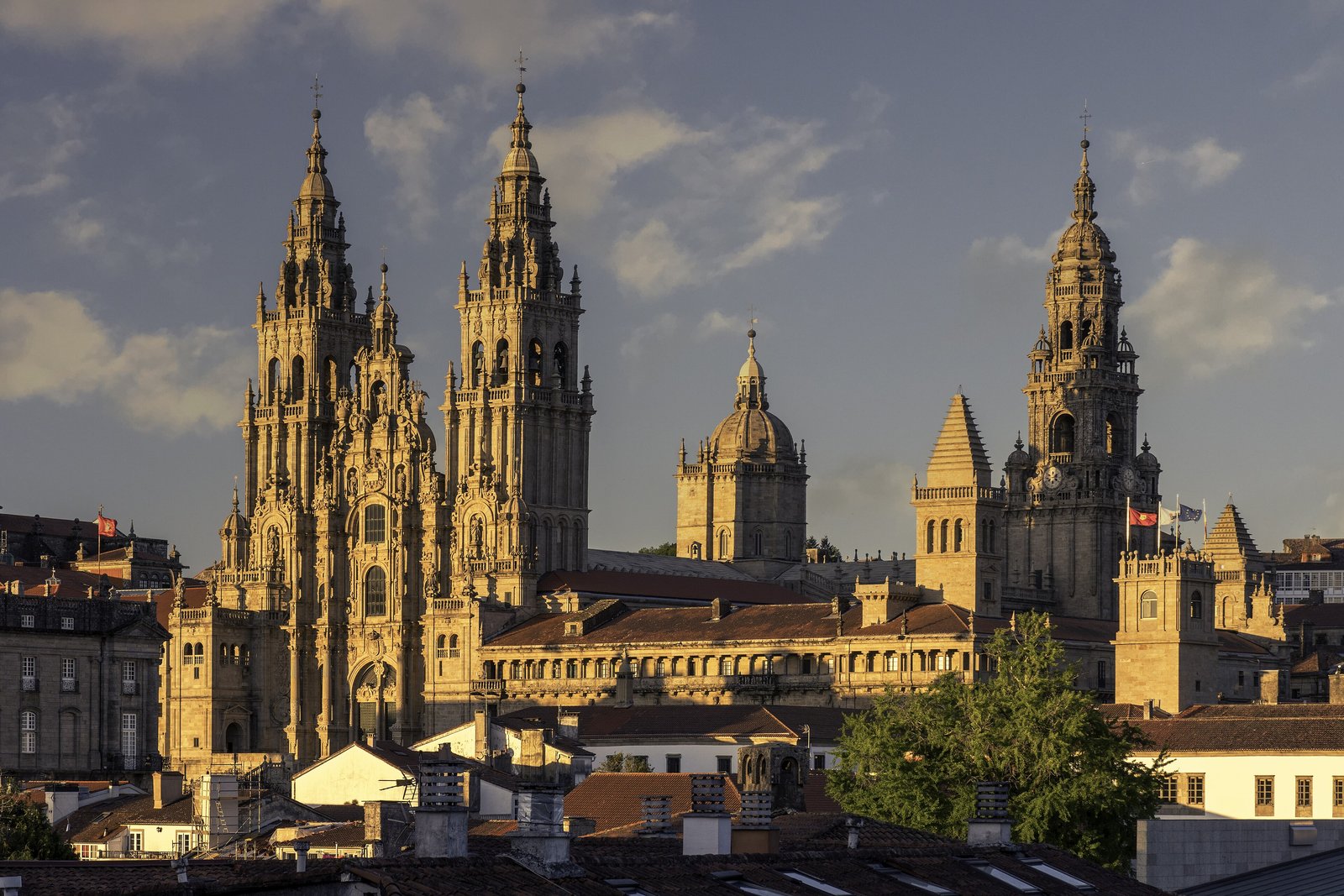
Santiago de Compostela is the capital of Galicia, in north-western Spain, and the end of the Camino de Santiago, the Way of St James: a network of pilgrimage routes across Spain, France and Portugal. Its cathedral is the reputed burial place of Saint James the Great. The identification rests on a ninth-century tradition: at some point between 818 and 842, in the account Wikipedia gives, Bishop Theodemar of Iria claimed to have found the apostle’s remains, and Pope Leo XIII’s bull of 1884 accepted them. The present cathedral was begun in 1075 and consecrated in 1211; its Baroque Obradoiro façade, by Fernando de Casas Novoa, was completed in 1740. UNESCO inscribed the Old Town in 1985 and the Camino Francés in 1993, extended in 2015 to the routes of northern Spain. The Council of Europe named the Camino its first Cultural Route in 1987.
Why it's worth knowing
A pilgrimage made since the Middle Ages is waymarked, for most of its length, with a symbol invented in the 1980s. The Galician government’s official Camino site says the yellow arrow was conceived in 1984 on the initiative of Eliás Valiña, the parish priest of O Cebreiro, and that in that year he set out to signpost the French Way with yellow arrows all the way from France to Compostela. It now appears on roads, houses, fences and trees, and the same site calls it one of the most international symbols of the Way.
How the colour was chosen is a family story. His niece, Pilar Valiña, has recalled, in a press account collected by the Spanish Federation of Associations of Friends of the Camino, that he looked for the cheapest paint available, found a leftover batch used to mark road works, and kept buying the same paint so the colour would not change; she describes him and his helpers driving the route in a small Citroën van loaded with paint and food from home. That account is hers, and the page gives it as hers.
The medieval proof of a pilgrimage was a scallop shell carried home from the Galician coast. The modern proof is a book of stamps. The Pilgrim’s Office of the cathedral awards the Compostela, the pilgrim’s certificate, to those who have walked or ridden at least the last 100 kilometres, or cycled the last 200, and who show it in their credencial, stamped at least twice a day over that stretch.
The field notes
The priest of O Cebreiro
Eliás Valiña Sampedro was born in Sarria in 1929 and died in 1989, and was known as o cura do Cebreiro, the priest of O Cebreiro, a mountain village on the French Way. The Galician government’s Camino site describes him as one of the most important conservers and promoters of the Way: in Galicia he also cleaned the path, recovered lost stretches and marked the kilometres.
The same site says his waymarking is now considered the surest guide to the original line of the route, and that in his will he asked his family to see that the yellow arrow was not lost on the Way, which they did with the help of the Associations of Friends of the Way. The Xunta de Galicia gives a prize in his name for work that revives the values of the Camino.
A passport of stamps
The credencial is the document on which pilgrims record their journey, and the Pilgrim’s Office calls it the official one. Stamps, sellos, are available in many places along the routes, particularly in the last 100 kilometres: in churches, hostels, hotels and town halls. Pilgrims’ hostels generally ask to see a credencial before giving a bed.
The Compostela itself is awarded, in the Pilgrim’s Office’s words, to those who come to the apostle’s tomb for religious or spiritual reasons, on foot, by bicycle or on horseback, and who meet the distance and stamp rules. It is written in Latin. Pilgrims who received it the day before have their countries and starting points announced at the cathedral’s pilgrims’ Mass, in Wikipedia’s account.
How many walk
On 19 October 2025 the cathedral handed out its 500,000th Compostela of the year, to a pilgrim from Colombia who had walked the Portuguese Way from Baiona. Numbers rise further in Holy Years, declared when St James’s Day, 25 July, falls on a Sunday; the most recent was 2021 and the next is 2027.
Wikipedia, citing the Pilgrim’s Office’s statistics for 2024, gives the French Way as the most walked route, with 47 per cent of certificates, ahead of the Portuguese Way at 19 per cent and its coastal variant at 15; the most common starting point was Sarria, chosen by 32 per cent; and 93 per cent of pilgrims came on foot.
The front at the end of the road
Most pilgrims arrive in the Praza do Obradoiro, the square in front of the cathedral’s west front, named for the stonemasons’ workshop that once stood there. The Baroque Obradoiro façade was built in the eighteenth century partly to protect what lies behind it: the Romanesque Pórtico da Gloria, carved by Master Mateo and completed in 1188, which weather had been damaging. The façade appears on the Spanish 1, 2 and 5 cent coins.
The name of the city is argued over. A folk etymology reads Compostela as campus stellae, the field of the star, after the lights said to have led a hermit to the tomb; Wikipedia reports that Richard Fletcher, Joan Coromines and Ramón Menéndez Pidal favour a Latin root meaning a well-ordered burial ground.
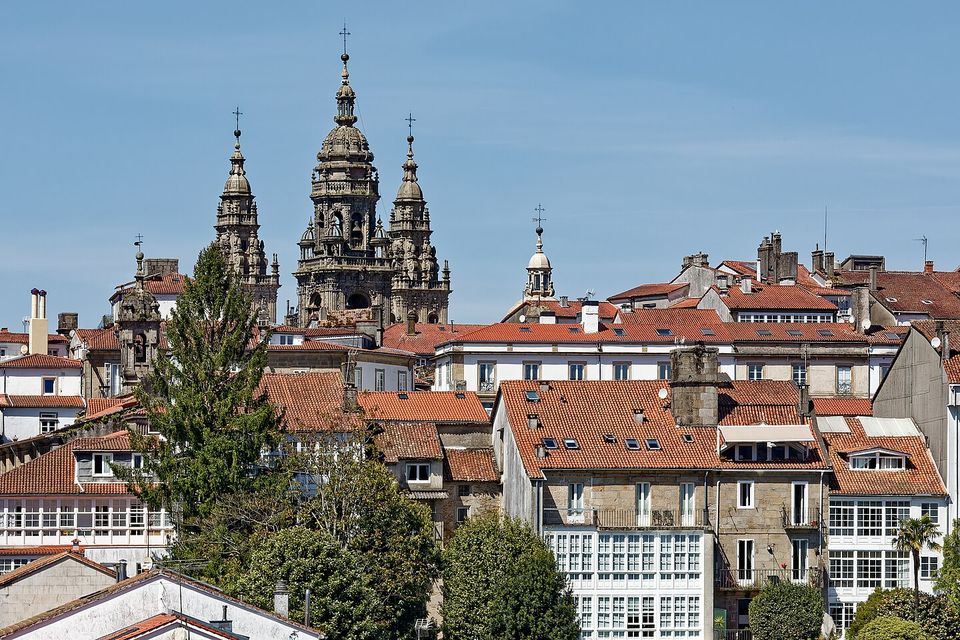
The cathedral's towers over the roofs of the old town, from the Rúa de Belvís.
Photograph: Luis Miguel Bugallo Sánchez · CC BY-SA 4.0 · cropped
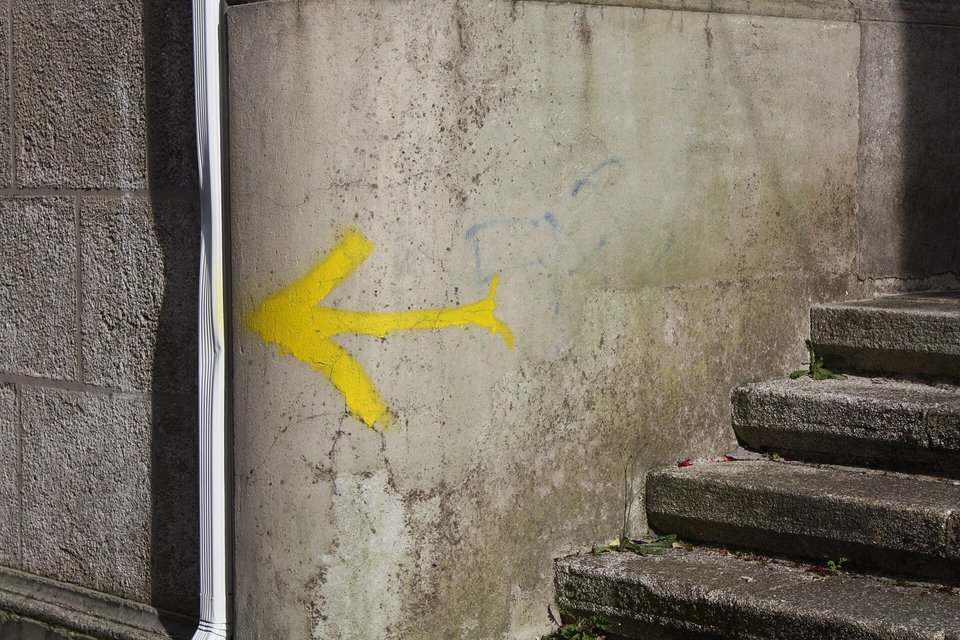
A yellow arrow painted on a granite wall in Arzúa, on the Way of St James in Galicia, April 2014.
Photograph: P.Lameiro · Arzúa, sinal 02 · CC BY-SA 3.0
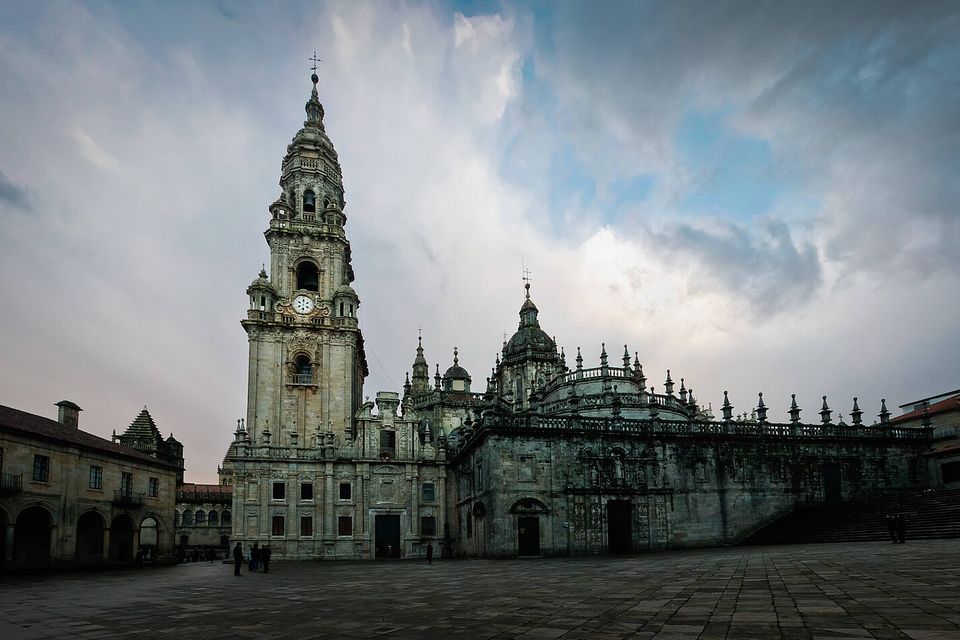
The Berenguela clock tower and the cathedral's east end from the Praza da Quintana, February 2013.
Photograph: D.Rovchak · CC BY-SA 4.0 · cropped
- Get your book of stamps before you set out, and collect them as you go, not in a rush at the end.
- Say the greeting back every time, even on the steepest hill of the day.
- Wear your boots in at home. The road will not wait for them.
- In the cathedral, remember that people have walked a very long way to pray there. Let them go first.
- Have the list stamped along with the little book. (They stamped it. It is now the most official document I own, and not one item on it is finished.)
A yellow arrow. Painted on a wall, a kerb, a post or a tree along the Way, pointing towards Santiago. The arrows began in 1984, when Eliás Valiña, the parish priest of O Cebreiro, set out to waymark the French Way from France to Compostela; in his will he asked that the arrow not be lost, and his family and the Associations of Friends of the Way kept it going. It asks nothing of the walker but to be noticed at the next turning.
Tally, in the marginA little yellow arrow on a wall, and somebody had to paint the first one. I have been nodding thank you to walls ever since, including several in other countries that had not earned it at all.
Getting there
How to get there. Santiago has its own airport and is on Spain’s rail network. To walk the last stretch as a pilgrim, start at least 100 kilometres out: Sarria, on the French Way, is the most common starting point because it has bus and rail connections.
Get a credencial first. The Pilgrim’s Office explains where to obtain one; pilgrims’ associations also issue them. Collect at least two stamps a day over the last 100 kilometres if you want the Compostela, and carry the credencial to the Pilgrim’s Office in Santiago at the end.
When to go. Most pilgrims finish between May and September. Santiago is among the wettest cities in Spain, with about 1,800 millimetres of rain a year, so pack for it in any season. Expect more walkers, and fuller hostels, in the Holy Year of 2027.
The cathedral. The cathedral is a place of worship with daily pilgrims’ Masses. Visits to the Pórtico da Gloria and to the cathedral roofs are by ticket through the cathedral’s own site, with reduced prices for accredited pilgrims and a limited number of free, unguided Pórtico visits; check the times and prices there.
Safety. The United States has Spain at Level 2, exercise increased caution, because of terrorism and civil unrest, with no area-specific warnings for Galicia.
Mark this place
Common questions
Who painted the yellow arrows on the Camino de Santiago?
The yellow arrows of the Camino de Santiago began with Eliás Valiña Sampedro (1929–1989), parish priest of O Cebreiro in Galicia. The Galician government’s official Camino site says he conceived the arrow in 1984 and that year set out to waymark the French Way with it from France to Santiago de Compostela; in his will he asked that the arrow be kept.
How far do you have to walk to get the Compostela?
The Pilgrim’s Office in Santiago de Compostela awards the Compostela to pilgrims who have walked or ridden on horseback at least the last 100 kilometres to Santiago, or cycled at least the last 200, for religious or spiritual reasons. The journey is proved by a credencial stamped at least twice a day over that last stretch.
What is a pilgrim credencial?
The credencial is the pilgrim’s passport of the Camino de Santiago, a folded document stamped at churches, hostels, hotels and town halls along the way. It gives access to pilgrims’ hostels and, presented at the Pilgrim’s Office in Santiago de Compostela with at least two stamps a day for the last 100 kilometres, proves eligibility for the Compostela.
Is Saint James buried in Santiago de Compostela?
The cathedral of Santiago de Compostela is the traditional burial place of Saint James the Great. The tradition dates from the ninth century, when Bishop Theodemar of Iria claimed to have found the apostle’s remains at some point between 818 and 842; Pope Leo XIII’s bull Omnipotens Deus accepted the relics in 1884. The identification rests on that tradition, not on independent evidence.
What does the name Compostela mean?
The origin of the name Compostela is disputed. A folk etymology derives it from the Latin campus stellae, “field of the star”, after the lights said to have guided a hermit to Saint James’s tomb. Wikipedia reports that the historians and linguists Richard Fletcher, Joan Coromines and Ramón Menéndez Pidal favour a Latin root meaning a well-ordered burial ground.
How many people walk to Santiago de Compostela?
More than half a million a year. The cathedral of Santiago de Compostela handed out its 500,000th Compostela of 2025 on 19 October 2025. For 2024, the Pilgrim’s Office’s statistics as Wikipedia reports them show the French Way as the most walked route, with 47 per cent of certificates, and Sarria as the most common starting point, with 32 per cent.
When is the next Holy Year in Santiago de Compostela?
The next Holy Year in Santiago de Compostela is 2027. The cathedral declares a Holy Year, or Xacobeo, whenever St James’s Day, 25 July, falls on a Sunday, which happens in intervals of five, six and eleven years; the most recent was 2021. Pilgrim numbers on the Camino de Santiago rise in Holy Years.
Is Santiago de Compostela a UNESCO World Heritage Site?
Yes, twice over. UNESCO inscribed the Old Town of Santiago de Compostela in 1985 and the Route of Santiago de Compostela, the Camino Francés, in 1993, extending it in 2015 to take in routes of northern Spain. The routes in France are a separate World Heritage Site. The Council of Europe named the Camino its first Cultural Route in 1987.